
For more than two and half decades, the International Space Station (ISS) has been a shining symbol of human curiosity, scientific discovery, and international cooperation. Floating high above Earth, it has served as a home for astronauts, a laboratory for groundbreaking experiments, and a testament to what humanity can achieve when nations work together.
But every great journey must eventually come to an end.
As the ISS approaches the final chapter of its remarkable life, NASA has entrusted SpaceX, founded by Elon Musk, with the enormous responsibility of bringing this giant safely back to Earth.
Under a contract worth up to $843 million, awarded by NASA, SpaceX will develop a specially designed spacecraft known as the U.S. Deorbit Vehicle (USDV).
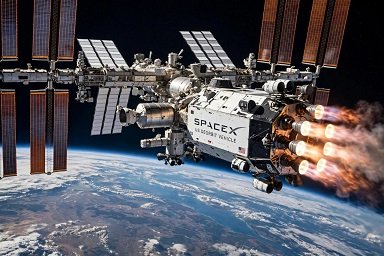
Its mission is extraordinary: to attach itself to the ageing space station, guide it out of orbit, and steer its remains towards a controlled fiery descent through Earth’s atmosphere around 2030.
The final destination will be Point Nemo, a remote region of the South Pacific Ocean, often described as the world’s spacecraft graveyard.
Once SpaceX completes and delivers the vehicle, NASA will take ownership and oversee its operation during the station’s final journey home.
How Will the ISS Make Its Final Journey?
Bringing down a 420-metric-tonne structure travelling thousands of kilometres above Earth is no ordinary task. It will require careful planning, precise calculations, and a series of carefully coordinated operations.
The farewell will unfold in several stages.
1. The Slow Descent Begins – Early to Mid-2028
The first step will be to gradually lower the ISS from its familiar orbit.
NASA and its international partners will allow Earth’s atmospheric drag to slowly pull the station closer to the planet. Orbital adjustments, supported by the Russian segment, will help manage its descent while conserving fuel.
It will be the beginning of the station’s long journey towards its final destination.
2. SpaceX’s Deorbit Vehicle Arrives – Mid-2029
Around 18 months before the planned reentry, SpaceX will launch a specially modified Dragon spacecraft to dock with the ISS.
This will not be an ordinary Dragon.
Equipped with 46 Draco thrusters and approximately 35,000 pounds of propellant — nearly six times the fuel capacity of a standard cargo Dragon — this powerful spacecraft will become the station’s final ride home.
Once docked, it will wait for the moment when its most important mission begins.
3. The Last Astronauts Depart – Around Six Months Before Reentry
As the station descends to approximately 205 miles (330 kilometres) above Earth, its final crew will bid farewell.
For the last time, astronauts will leave the familiar corridors, laboratories, and living quarters that have been their home in space.
After their departure, the ISS will continue its journey without a human presence onboard.
A remarkable chapter of human space habitation will quietly come to a close.
4. The Final Push Towards Earth
As the station approaches an altitude of approximately 140 miles (225 kilometres), the Deorbit Vehicle will begin a series of carefully calculated engine burns.
These manoeuvres will align the station with its intended reentry path.
Then comes the decisive moment: one powerful final burn.
The spacecraft will push the massive station towards Earth’s atmosphere, setting in motion its irreversible descent.
5. A Fiery Farewell Above the Pacific Ocean
As the ISS plunges into the atmosphere, the enormous heat generated by friction and compression will begin tearing it apart.
Its solar panels and exposed external structures will break away first. Much of the station will burn up in the intense heat.
However, some of its denser, heat-resistant components may survive the journey.
These remaining fragments will fall into the vast, uninhabited waters surrounding Point Nemo in the South Pacific Ocean.
There, far from human settlements and busy shipping routes, the remains of one of humanity’s greatest engineering achievements will find their final resting place.
And just like that, the ISS will complete its extraordinary journey — from a symbol of human achievement in orbit to a collection of fragments resting beneath the Pacific Ocean.
What Will Replace the ISS After 2030?
The retirement of the International Space Station does not mean the end of humanity’s presence in low Earth orbit.
Instead, it signals the beginning of a new era — one in which private companies, rather than governments alone, will take a leading role in building and operating space stations.
NASA is gradually moving away from the traditional model of owning and operating a massive space station. Its new approach is to become a customer, purchasing services from privately developed and operated space stations.
Several exciting projects are already taking shape.
Key Commercial Space Station Projects
Instead of a single successor, the post-ISS landscape will be a fractured, highly competitive ecosystem of privately built orbital hubs:
| Station Project | Primary Developers | Core Design Strategy & Timeline |
|---|---|---|
| Axiom Station | Axiom Space | The Parasitic Approach: Rather than launching independently, Axiom will attach its initial commercial modules directly to the ISS forward port starting no earlier than 2028. Over the subsequent years, it will add habitat and manufacturing modules before physically detaching to operate as a fully independent, free-flying station before the ISS deorbits. |
| Orbital Reef | Blue Origin & Sierra Space | The Free-Flyer: Designed from day one to launch directly into LEO as an independent commercial “business park” in space. It utilizes Blue Origin’s heavy-lift New Glenn rocket and Sierra Space’s expandable LIFE (Large Integrated Flexible Environment) habitat modules. |
| Starlab | Voyager Space, Airbus, & Lockheed Martin | The Research Heavyweight: A venture targeted to launch no earlier than 2029. It focuses on providing end-to-end laboratory and microgravity research services for both sovereign space agencies and private corporations. |
| Haven-1 | Vast | The Outlier: While not part of NASA’s original Phase 1 development awards, Vast’s Haven-1 is currently the closest to flying. It is a single-module station that will launch fully assembled on a SpaceX Falcon 9, targeting an aggressive launch window as early as 2027 to capture the early private astronaut market. |
NASA’s New Space Strategy: From Landlord to Tenant
NASA is preparing for a major transformation in space exploration. Instead of owning and operating the next generation of space stations, it plans to let private companies build, own, and manage them — while NASA simply rents the facilities it needs.
With its final Request for Proposals (RFP), NASA has launched a multi-billion-dollar competition to select companies that will shape the future of commercial space stations.
The Four Key Developments
1. Request for Proposals (RFP)
NASA has invited private companies to submit their technical designs, business plans, and financial bids for building future space stations. The stated submission deadline is December 8.
2. Multiple Winners, Not Just One
NASA plans to select at least two companies in Spring 2027, encouraging competition and ensuring backup options if one project faces difficulties.
3. Firm-Fixed-Price Contracts
Unlike traditional cost-plus contracts, companies will generally have to absorb costs that exceed their agreed contract price. This shifts more financial risk to private developers and offers taxpayers greater cost certainty.
4. The 2030 Deadline
With the ISS approaching retirement around 2030, the selected companies will face a challenging race to develop and launch their initial space-station capabilities.
No matter which space tech giant among the Axiom Space, Starlab, Vast and Blue Origin wins the NASA’s contract for building future space station, great commercial opportunities are unfolding for small space tech investors and startups.
The New Space Economy: A Golden Opportunity for Startups and Investors
The next space revolution will not belong only to giants like SpaceX, Blue Origin, or NASA. It could also create extraordinary opportunities for small technology startups, ambitious entrepreneurs, and visionary investors.
As NASA moves from owning space stations to renting services from private operators, companies such as Axiom Space and Vast Space will need a vast network of technology partners and specialist suppliers.
No single company can build everything. And that is where the real opportunity begins.
1. Where Can Startups Make Their Mark?
Instead of building entire space stations, smaller companies can focus on specialised technologies that make these stations smarter, safer, and more efficient.
- Space-Ready Components: Radiation-resistant electronics, life-support sensors, leak detectors, and advanced propulsion components.
- Space Robotics and AI: Intelligent robotic arms, automated docking systems, and autonomous maintenance robots.
- Research and Manufacturing Facilities: Miniature laboratories, pharmaceutical research equipment, and automated systems for manufacturing materials in microgravity.
- Space Computing and Cybersecurity: Space-hardened servers, orbital data processing, cloud infrastructure, and cybersecurity systems.
The opportunity is simple: build one essential technology that every space station needs, and become an important part of the emerging space economy.
2. Why Are Investors Looking Towards Space?
For venture capitalists, angel investors, and private equity firms, commercial space stations represent a new investment frontier.
NASA’s planned 2027 contract awards could provide an important confidence boost by signalling government demand for commercial space services.
Three areas are particularly attractive:
- The Picks-and-Shovels Business: Investing in essential components and technologies that multiple space-station developers will need, regardless of who wins NASA’s contracts.
- Microgravity Manufacturing: Supporting companies that use the unique conditions of space to develop advanced medicines, protein crystals, human tissues, and specialised materials.
- Strategic Acquisitions: Investing early in promising technologies that larger aerospace companies may eventually acquire to strengthen their supply chains.
3. Three Technology Sectors Attracting Investment
A. Space-Based Biomanufacturing
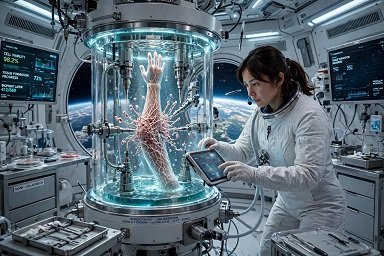
Microgravity could enable the production of complex human tissues, advanced medicines, and highly pure protein crystals.
Companies such as LambdaVision and 3D Bioprinting Solutions are exploring the possibilities of manufacturing biological products in space.
B. Advanced Materials and Semiconductors
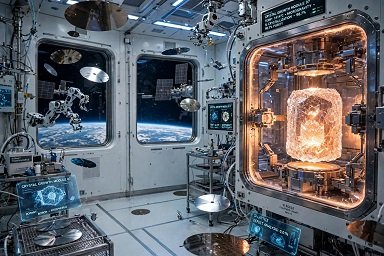
Space offers a unique environment for developing specialised materials, including ultra-pure crystals and advanced optical fibres.
Companies such as Flawless Photonics are exploring ZBLAN fibre production, which could offer lower signal loss than conventional optical fibres.
C. Orbital Data Centres and Edge Computing
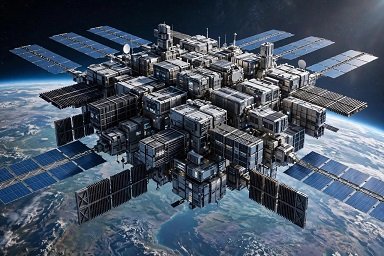
Future space stations will generate enormous amounts of scientific and operational data.
This creates opportunities for startups developing space-ready servers, AI processors, orbital cloud infrastructure, and secure data-processing systems.
The Bigger Picture: Space Is Becoming a Business Destination
The next space economy will not be built by rocket companies alone.
It will need engineers, software developers, robotics specialists, biotechnology researchers, semiconductor manufacturers, cybersecurity experts, and investors willing to take calculated risks.
For startups, the opportunity may lie in building one small but indispensable piece of a much bigger space ecosystem.
For investors, it may be about identifying tomorrow’s essential space technologies before they become industry standards.
The next generation of space billionaires may not necessarily be those who build rockets or launch astronauts. They could be the entrepreneurs who build the technology, materials, medicines, and infrastructure that make living and working in space commercially possible.